

Potting young plants from plugs into larger pots within four months seems to reduce root-crown disorder risk within the first year of planting, depending on variety
Longer plug dwelling appears to be linked to more cane detachment, and thinner shoots and roots at least for one of the varieties tested
Current data found no major tissue culture duration effect in the variety studied so far
Blueberry growers across Australia and overseas have raised concerns about a physiological disorder affecting the root-crown region of the plant; observed symptoms include root curling and wrapping around the crown (with suspected girdling), restricted crown development, cane snapping (possibly linked to bark inclusion), and abnormal tissue growth at the root-crown junction. Left unchecked, these symptoms are suspected to disrupt the plant's vascular system, contributing to cane dieback, reduced yield, and in severe cases whole-plant death under high water and nutrient demand.
Funded by Hort Innovation using the blueberry industry levy and contributions from the Australian Government, this UQ-led project (BB23000) is now in its second year, working to pin down the physiological causes of the disorder and identify which propagation and nursery practices influence its onset or severity, with the end goal of practical, evidence-based guidance for industry.
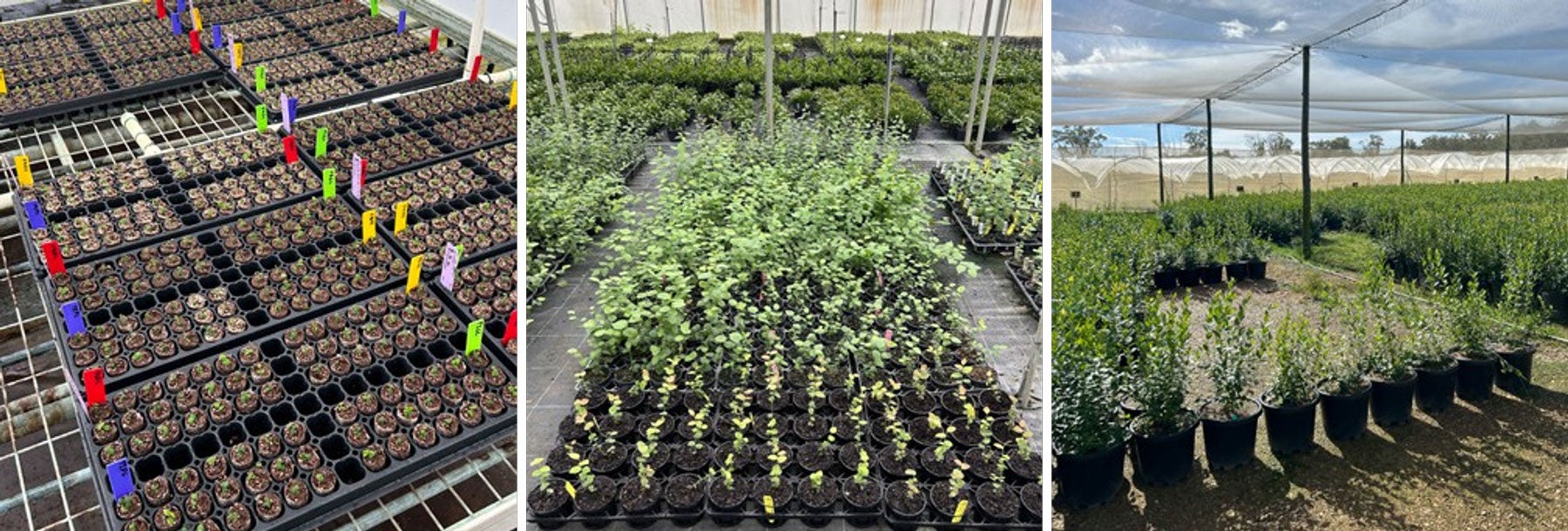
What we've done
Working closely with industry partners Harts Nursery, Costa, and Mountain Blue Farms, the team has established large-scale nursery trials across multiple commercial varieties, testing four variables during standard nursery production suspected to influence disorder risk:
- Propagation material type: tissue culture vs. tradtional cuttings
- Rooting hormone strength: a hormone-free control against three commercial IBA concentrations used to induce the roots on cuttings or tissue-cultured shoots
- Plug dwelling time: how long young plants remain in small propagation plugs before potting up
- Trimming method and frequency: mechanical vs. hand trimming, and how often
Plants from all four trials have now progressed from nursery through to field planting across sites in NSW (Corindi and Tabulam) and are being tracked into their first year in the field.
A second round of dwelling-time trials, testing even shorter durations, was added in October 2025 and is due for field planting in late 2026.
In parallel, two tissue-culture (TC) propagation experiments are examining factors further upstream in the supply chain: whether clone origin and time spent in tissue culture affect plant development (Experiment 1), and whether hormone-reducing treatments applied during the final TC stage — including activated-charcoal and hormone-free media — can improve later plant establishment (Experiment 2).

Both have progressed from TC stage through early nursery growth. Supporting this work, the team has developed and validated an in-house Liquid
Chromatography–Mass Spectrometry (LC-MS) method to quantify endogenous plant hormones (cytokinins, auxin, gibberellins, and abscisic acid) in blueberry leaf and stem tissue, allowing them to test whether hormone exposure during propagation carries over into nursery and field performance. LC-MS (liquid chromatography–mass spectrometry) is a laboratory technique used to separate, identify and measure chemical compounds within plant samples.
A full year of quarterly monitoring has also been completed on existing commercial plantings at Costa's Dirty Creek site, tracking around 260 tagged plants across two TC propagation batches to benchmark normal versus disordered growth in a real production setting.
Separately, a 20-question industry survey — developed with UQ ethics approval and promoted at BerryQuest International 2025 and through industry channels — closed in April 2026 with 28 valid responses (including 5 international) and is now being analysed to characterise how the disorder is being experienced across the industry. The team has also completed a literature review of global blueberry propagation and cultivation practices, which is heading toward journal submission later this year.
Finally, the project's research capacity has grown with a new UQ-funded PhD student Nhu Quynh Thi Truong, who joined in late 2025 to investigate how nutrition, growing substrate, and genetics shape early root development, working with international blueberry nutrition expert Dr Gerardo Nunez (University of Florida). She is trialling substrate types, a phytagel-based non-destructive root visualisation system, and a DIY root chamber, and has begun sourcing a wider range of blueberry varieties from industry partners to broaden the genetic scope of this work.
What we've found
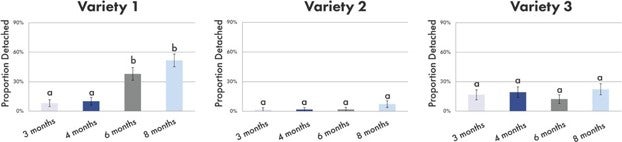
The clearest actionable result to date concerns plug dwelling time. In field surveys of the dwelling-time trial, plants of one tested variety that spent longer in nursery plugs before potting up showed significantly higher rates of branch/cane detachment once established in the field.
In this variety, around 35% of plants held in plugs for 8 months developed detachment symptoms — roughly a quarter of these fatal — compared to markedly lower rates in plants potted up earlier (3–4 months), as shown in Figure 2.
Basal shoot count and cane thickness followed the same pattern: plants dwelling longer in the plug consistently developed thinner shoots and roots than those moved on sooner.
Alongside this, a year-long quantitative survey of existing commercial fields in Corindi found no strong difference in above-ground disorder symptoms between plants from different tissue-culture propagation batches (different duration of time spent in culture), for the single variety examined. That survey also found that plants carrying more total basal stems/canes were more likely to show cane snapping and other disorder-associated symptoms in the first five months post-planting. This is consistent with one hypothesis that higher numbers of canes may influence cane snapping potential through increased competition or poorer vascular connectivity into the crown, influencing a young plant's root-to-shoot supply capacity.
Early tissue-culture experiments examining the influence of mother-plant clone number and hormone-reducing treatments during propagation are also underway, though these remain at an early nursery stage and results so far show limited effect on measured plant physiology traits. This work will be reported in more depth as it progresses to the field.
Why this matters for growers
Dwelling time is one of the few disorder-associated factors suspected by industry, and now also validated in our data so far, that sits within a nursery's control. However, the degree of
impact appears to depend on variety at least in our early data.
These findings support a best practice of potting up young plants from plugs into larger pots sooner (4 months or less) rather than leaving them in small plugs for extended periods.
Plug dwelling periods of two to four months are currently being investigated in more detail to better narrow down best practise timings under our growing conditions.
Our current data does not suggest a major concern with time in tissue culture (batch), at least for the one variety and for the TC durations analysed in our survey to date, in the first year of field growth.
We will continue to monitor the impact of tissue culture treatments, clones, batches, and nursery variables for multiple varieties over the next year.
What's next
Second-round dwelling time trials — testing even shorter durations down to 8 weeks — are underway, alongside continued monitoring of the hormone, trimming, and propagation-
method trials as they establish in the field.
The two tissue-culture experiments (clone/time-in-culture and hormone-reducing treatments) are
continuing through nursery stage, with field planting scheduled for October 2026. Root architecture assessments (requiring destructive sampling) and first yield data are planned through late 2026 and into 2027, which will allow the team to connect these early nursery-stage patterns to field disorder and crop outcomes. The industry survey results and literature review are both progressing toward publication, and the new PhD project examining nutrition, substrate,
and genetics in early root development is underway to broaden the picture further.
The ‘Understanding Blueberry Root-Crown Disorder’ progress update article by Dr Eveline Kong, William de Stefani, Nhu Quynh Thi Truong, Dr Madeleine Gleeson, Dr Alison Kelly, Dr Gerardo Nunez, Dr Chris O’Brien, Dr Thi Thao Ninh and Dr Alice Hayward from The University was published in the Spring 2026 edition of the Australian Berry Journal.
The ‘Understanding the cause of blueberry root wrapping and associated root crown disorders’ (BB23000) project is funded by Hort Innovation via the blueberry levy fund. The initiative is led by The University of Queensland with support from QAAFI, Costa , Mountain Blue, and Harts Nursery.
Growers interested in following this project's progress, or wanting to contribute observations from their own operations, are encouraged to contact the team at QAAFI, The University of Queensland at: a.hayward@uq.edu.au or e.kong@uq.edu.au
The Queensland Alliance for Agriculture and Food Innovation is a research institute at The University of Queensland, established with and supported by the Queensland Department of Primary Industries.